
Our researcher Jas and her review of 3d Printing in Medicine last week in the Medical Journal of Australia has been featured on the Austin Health Website and Facebook page. More of our publications are available here. Enjoy!
Jas says: Come to the 3d Med Symposium!
Learn about the future of medicine, surgery, and 3d printing at the 3d Med Symposium. Register now to secure your spot!

Dr Jay invites you to 3d Med!
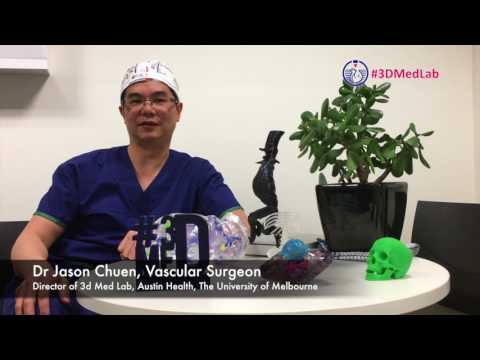
Our 3dMed Symposium Convenor and Director of 3dMedLab invites you to come on the 25th of August! Make sure you register now!
3dMed 2017 is Coming!
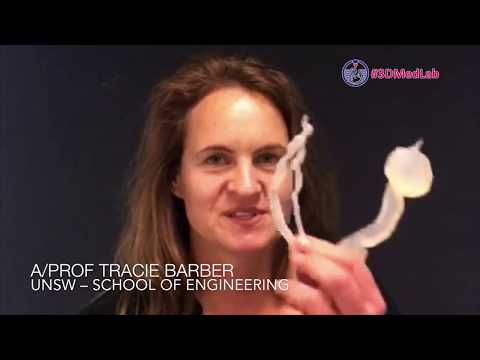
As we draw closer to the 2017 3dMed Symposium one of our key speakers, Associate Professor Tracie Barber, invites you to register. Don’t delay – do it now!
MJA: Three Dimensional Printing in Medicine
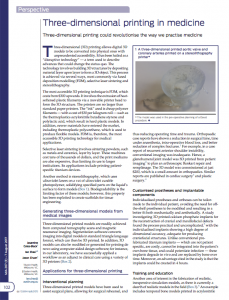
It has taken a while, but our review paper on 3D Printing in Medicine has finally been published in the Medical Journal of Australia.
Coles-Black J, Chao I, Chuen J. Three-dimensional printing in medicine. Med J Aust. 2017 Aug 7;207(3):102–3.
doi: 10.5694/mja16.01073
Happy Day!
Don’t you love that feeling when you get an email saying that your manuscript has been accepted? We do!
Publication day is August 7, 2017. Any press looking for interviews are welcome to contact us directly or via Austin Health Corporate Communications. Please respect embargo.
Austin Medical 3d Printing Symposium Satellite Workshop
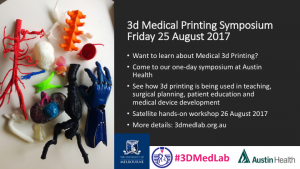
As our Australian 3dMed Symposium nears, we are happy to announce that we will be running a one-day hands-on satellite workshop on Saturday 26 August!
After you have heard all about the applications of 3d Printing and Modelling in Medicine you will want to have go for yourself! Keep your eyes peeled as we will be announcing details soon!
In the meantime, make sure that you register for the #3dMedAu17 Symposium. Details are available here.
Call for Abstracts Extended!
 If you have an abstract for the #3dMedAu17 Symposium don’t fret!
We know how much work you put into that 3D Imaging or 3D Printing project so here is your chance — the abstract submission deadline has been extended to 19 May 2017.
Send your abstract now to 3dPrintLab@austin.org.au!
A Brief History of 3dMedLab
3dMedLab came about after discussions about the need for a more co-ordinated and organised approach to 3D Printing Resources throughout The University of Melbourne and in particular the availability of this technology to Clinician-Researchers at hospitals associated with the Faculty of Medicine, Dentistry and Health Sciences.
After a very pleasant Friday-afternoon multidisciplinary meeting in late 2014 at the venerable Prince Alfred Hotel the concept of an open and collaborative 3D Printing facility was born.
Form2 Unboxing Day
Here at the 3DMed Lab, we have had our eye on the Form 2 Desktop SLA 3D Printer for a long while. So when it finally arrived only a few days after it had been ordered, you can guess how excited we were!
Boxes, boxes and more boxes

FormLabs Form2 Boxes
The Form 2 “Complete Package” consists of the printer itself, one cartridge of Clear resin, a resin tank, a build platform, and a finish kit. We also ordered extra Grey and Flexible resins, as well as an extra build platform and resin tank, as we’ve heard that switching between resins can be a pain. The Form 2 also has “Open” mode which allows you to experiment with third party resins. We will report back when we have done so.
Stoked and Stacked!
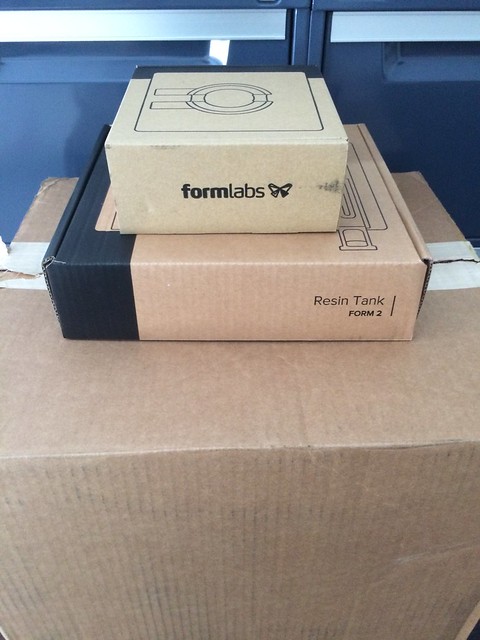
FormLabs Form2 boxes
The Form 2 itself came snugly packed in its box. The cardboard handles on either side were a nice touch which facilitated easy lifting out of the box and onto the table.
You lift me up...

FormLabs Form2 in the box
The finish kit was packed full of very handy tools for post-processing, tools that you would have had to purchase anyway from a hardware shop if you’d had any prior experience with 3D printing, but including them was a very nice touch. Included was also a very generous amount of gloves- two packets in fact! Not that we ever run short of gloves in a hospital, but the thoughtfulness was much appreciated.
Twins!
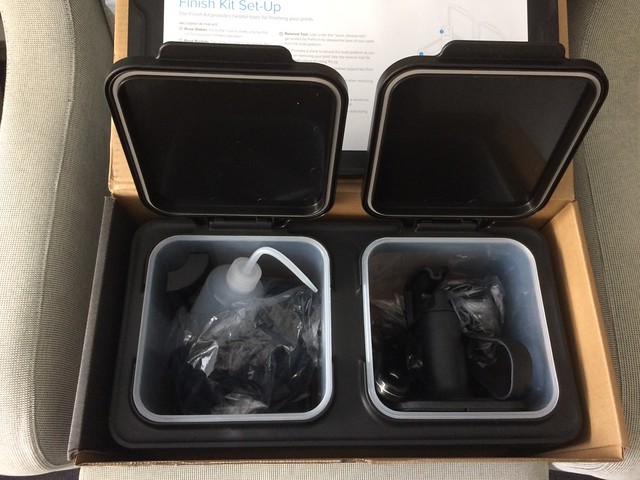
FormLabs Form2 cleaning kit
My only complaint is that the packaging did not contain an Australian power plug, which was slightly annoying as it meant that I couldn’t start printing straightaway. Just something to keep in mind when purchasing your Form 2- especially if you’re not setting up the printer at home, have a US to Australian adaptor at the ready so you don’t have to delay playing with your new toy! Thankfully the printer has a standard IEC power socket on the back so there is a good chance you have a suitable power cable sitting around from that retired computer, printer etc.
Other than that, assembly was very straightforward and the printer was pretty much plug and play. You have the option of printing via Wifi, ethernet, or directly to the computer via USB.
I'm sinking in foam!

FormLabs Form2 out of the box
The PreForm software was easily downloaded from the Formlabs website, and was very intuitive and straightforward to use. It has the option to optimally orient your print, which is great for SLA beginners like myself.
Orbit Model, PreForm

Skull and Orbit Model being manipuated in FormLabs PreForm software prior to 3d printing. The lattice network are support structures used to hold the model together during printing.
We had a model that we had prototyped in ABS using our Makerbots, and this seemed like the perfect opportunity to try it out in clear resin!
Skull, Meshmixer.

Skull and orbit model being manipulated in Autodesk Meshmixer software.
The original STL file was hollowed out using Meshmixer as per this tutorial on the Formlabs website, which was a relatively simple process. This allows you to shorten the build time and save on resin. As instructed, I reoriented the model to match the position PreForm had oriented it for printing, placing holes on the close to the build platform to allow resin to drain.
In addition to the hollowing tutorial, the Formlabs website has lots of very useful tutorials to help you get started. Formlabs were also very helpful on Twitter, responding to questions and linking me to further tutorials.
And here is the final hollowed model, imported back into PreForm:
The Crystal Skull
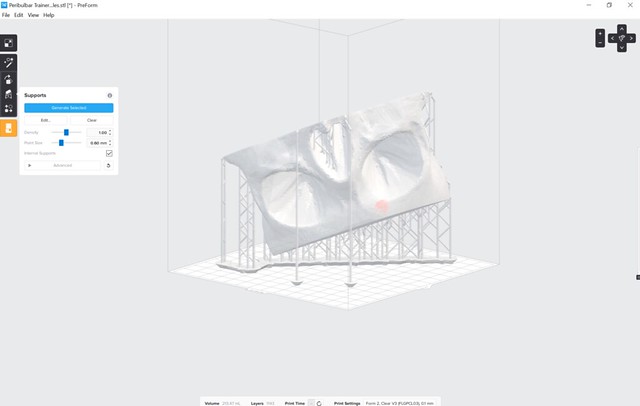
FormLabs PreForm software
What have been your experiences with the Form 2, or other SLA/DLP 3D printers in general? Have experiences or advice you would like to share? Leave a comment below or tweet us @3dMedLab!